
Technology has been part of my life for much longer than Harding Legacy Group has existed. Before I understood anything about servers, networking, databases, or building websites, I was simply a kid who enjoyed gaming, reading, writing, and figuring out what computers could help me do. In elementary school, I would sometimes stay inside during recess so I could type stories on a computer and look up ideas that might make them better. I also remember using educational software that let us choose topics and then recommended stories or history lessons based on what it thought we might enjoy. At the time, I wasn’t thinking about a future in technology. I was just discovering that a computer could be a tool for learning, research, creativity, and exploration.
That interest kept growing as I got older. In high school, business and technology courses introduced me to more specialized software and even 3D modeling through programs such as LightWave 3D. Later, I took coding classes, learned more about file management and business software, and eventually earned an associate degree in computer information systems. I also gained hands-on experience through building computers from individually selected components and troubleshooting my homely, computers of my own and those who saw me as “the tech guy”. Those experiences taught me the technical side of computers, but they also reinforced something that has become even more important to me: I don’t need to already know every answer before I start working on a problem. If I understand enough to identify what I don’t know, I can usually research it, test it, and learn my way forward.
That mindset is a major reason Harding Legacy Group exists in the form it does today.
Why I Chose to Build the Website Myself
I had experimented with website builders such as Wix, Squarespace, and similar platforms long before Harding Legacy Group became a serious project. They make it incredibly easy to get a basic website online, and for many people that convenience is probably exactly what they need. My frustration was that I always seemed to reach a point where the platform decided what I could and couldn’t do. I would want more storage, a different design, or a feature that required another subscription or a more expensive plan. The easier the platform made in the beginning, the more I noticed the limitations once I wanted something more specific.
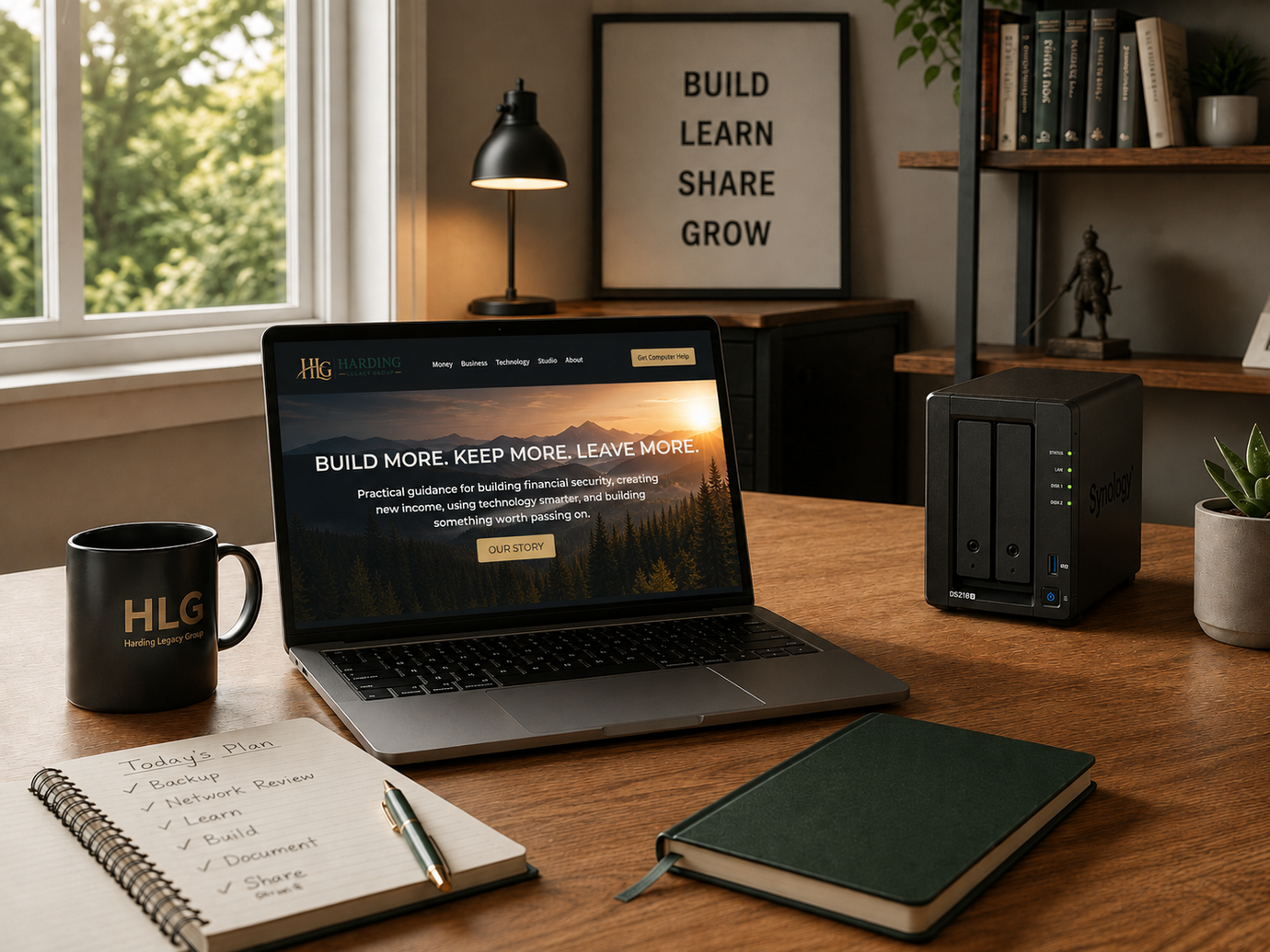
When I finally started building Harding Legacy Group, I decided I wanted more control. Instead of paying for traditional managed hosting, I chose to use hardware I already owned and self-host the site from my Synology NAS. WordPress became the foundation, with tools such as Docker, a database, Cloudflare services, and Kadence helping connect the pieces. That setup certainly took more effort than choosing a template and pressing publish, but that extra effort was part of the appeal. I wanted the website itself to become a project that challenged me to use what I had learned and expand into areas I had never implemented on my own before.
Self-hosting has also given me a different relationship with the site. Rather than thinking of Harding Legacy Group as something that lives inside another company’s platform, I understand much more about how the different parts work together. I’ve had to think about file structures, databases, domains, DNS, storage, web traffic, backups, security, and the connections between all of those systems. I’ve had to learn why something can work perfectly on my local network but fail when I try to access it publicly, and why a design can look right inside an editor but behave differently once it reaches the live site.
Self-hosting Harding Legacy Group wasn’t only about saving money. It gave me something I value just as much: the opportunity to learn.
Most of What I Know Came From Having to Figure It Out
Even with formal education and prior technology experience, there was very little about the complete Harding Legacy Group setup that I already knew how to do from beginning to end. I had taken coding classes and worked with computers for years, but I had never independently assembled all of these systems into a functioning public website. I had to research how to connect a domain, expose the site securely to the internet, configure the software, troubleshoot databases, and understand why certain functions behaved differently than I expected.
That has been one of the most valuable parts of the project. A one-click website builder hides most of that complexity, which is useful when speed is the priority. Building it myself forced me to understand more of what is happening behind the screen. I’ve learned how important file structure can be, how databases interact with applications, how different services communicate, and how much of the internet depends on layers of systems that most of us never think about when we open a website.
I’ve also learned that technical problems usually become much less intimidating once they are broken into smaller pieces. There hasn’t been one single issue that I would call impossible. Some problems have definitely been frustrating, especially when I tried to code much more of the website myself early on, but most eventually became manageable once I understood what I was actually trying to solve. Even the smaller challenges I am still working through, such as getting domain-based business email to route the way I want, are opportunities to learn something I can use again later.
How I Use AI Without Letting It Replace the Learning
Artificial intelligence has become one of the tools I use when I run into something unfamiliar. I don’t see it as a replacement for understanding technology, and I don’t assume every answer it gives me is automatically correct. What it has done is make the learning process faster and more approachable.
When I encounter an error or configuration problem, AI can help me break the problem into steps, explain terminology I don’t understand, or point me toward areas worth investigating. If that doesn’t solve the issue, I move to product documentation, technical forums, and other resources. The combination works well for me because I can use AI to get oriented and then verify or expand on what I’m learning through more traditional sources.
That has changed what I feel comfortable attempting. Years ago, something like self-hosting a business website might have felt like a project I should leave to someone who already knew every system involved. Now I’m much more comfortable starting with the knowledge I already have and learning the rest as I go.
I think that is one of the most important lessons technology has taught me. Knowing everything is unrealistic. Knowing how to research, test, troubleshoot, and keep learning is far more valuable.
Why Technology Is Part of the Larger HLG Mission
Technology is not a separate interest that happens to have its own page on Harding Legacy Group. It supports almost every other part of what we are building.
Our financial systems rely heavily on technology. I use spreadsheets to track spending, compare expenses, organize our household finances, and make better decisions with the information we have. Business ideas often begin with research and analysis that would have taken far more time before modern tools were available. Harding Legacy Studio depends on digital design, 3D modeling, printing equipment, photography, and software. The website itself connects everything and gives me a place to document the process.
Technology can also reduce costs when it allows us to use resources we already own instead of adding another subscription. Self-hosting is one example, but the larger principle applies to many areas. Sometimes the right piece of software saves time. Sometimes understanding a computer well enough to repair or upgrade it means a family doesn’t need to replace it. Sometimes using an existing device in a different way can solve a problem without buying anything at all.
That is the type of practical technology I want Harding Legacy Group to focus on. I’m interested in new tools, but I’m more interested in what those tools actually help people accomplish.
What I Want the Technology Section to Become
Over time, I want the Technology section to help people feel more comfortable with computers instead of making technology seem more complicated than it needs to be. Some readers may want to understand why their computer is running slowly or whether an upgrade makes more sense than replacing it. Others may be trying to figure out backups, home networking, software, security, self-hosting, or which tools are actually worth paying for.
I want to cover those subjects in a way that explains both the solution and the reasoning behind it. The most expensive computer isn’t automatically the right computer. Self-hosting isn’t automatically better than paying for a service. A new device isn’t always necessary simply because the current one is a few years old. Good technology decisions depend on what someone is actually trying to accomplish, how much time they want to invest, and what level of complexity makes sense for their situation.
That also means being transparent about the tools I use myself. I’m comfortable discussing the Synology hardware behind this site, the computers I use, WordPress, Kadence, Cloudflare, Docker, design software, printers, and other technology that becomes part of Harding Legacy Group.
Technology Gives Us More Ways to Build
What keeps me interested in technology is not simply that computers become faster or that new software is released. What matters to me is that the right technology expands what a person is capable of doing.
A computer once helped me write stories and research ideas as a child. Today, similar tools allow me to build and host a website, manage our household finances, learn unfamiliar skills, troubleshoot systems, research business ideas, create digital designs, and eventually turn some of those designs into physical products. The technology has changed dramatically, but the reason I am drawn to it has stayed surprisingly similar.
It gives me a way to explore an idea and see how far I can take it.
The biggest thing technology gives our family is the knowledge and freedom to expand our creativity, understanding, and ability to build things we could not have built on our own.
That is what I want the Technology side of Harding Legacy Group to represent: practical tools, continued learning, and a willingness to figure things out instead of assuming something is beyond our reach.