When I started thinking about what Harding Legacy Group could eventually become, I knew I didn’t want everything we created to remain entirely digital. Articles, spreadsheets, guides, and services can all be useful, but I have always been attracted to the idea of making something physical as well. There is something satisfying about beginning with an idea, working through a design, producing it, and eventually being able to hold the finished product in your hands.
That is where Harding Legacy Studio comes in.
The Studio is still an experiment. I have product ideas, equipment I already own, equipment I am waiting for, and far more questions than answers about what will actually sell. I don’t know yet whether Studio will eventually become a significant source of income, a smaller creative part of Harding Legacy Group, or something different from what I currently imagine. Rather than waiting until I know the ending, I want the process itself to become part of what we document.
Returning to a Creative Side I Had Put Away
My interest in 3D printing is connected to creative interests I have had for years. In high school, I worked with 3D animation and software such as LightWave 3D. I have also always enjoyed anime, fantasy, games, storytelling, and the kind of creative worlds that can make you want to build something of your own.
As life became busier, much of the way I used computers became practical. Technology meant troubleshooting, working, organizing files, managing systems, or solving a specific problem. The creative side never completely disappeared, but it wasn’t something I spent nearly as much time developing.
3D modeling and UV printing have given me an opportunity to reconnect those interests. A design no longer has to remain an image on a screen. It can become a miniature, a statue, a bookmark, a keychain, a textured photograph, or something I haven’t even thought of yet.
That combination of art and technology is what makes Studio particularly interesting to me. It gives me another way to express an idea while also creating something that might eventually become a viable product.
Why This Technology Feels Worth Exploring
Part of the appeal of newer 3D and UV printing technology is that capabilities that were once available mostly to larger commercial businesses are gradually becoming accessible to individuals and small companies. Traditional filament 3D printing has already developed into a huge maker community, and newer systems continue expanding the types of objects and finishes that smaller creators can produce.
I don’t assume that being early means there will be no competition. As equipment gets cheaper and easier to use, more people will enter the market. That is exactly what happened with traditional 3D printing, and I expect newer printing technologies to follow a similar path.
The opportunity, for me, is not simply owning a machine that fewer people currently have. It is learning what I can create with it before the technology becomes completely ordinary. If I can develop skills, original designs, a portfolio, and an understanding of the production process while the tools are still evolving, those skills may become more valuable than the machine itself.
That distinction matters because equipment does not create a business on its own.
Buying a printer does not create customers. The machine is only a tool; whether it becomes valuable depends on what I learn to create with it.
The Products I Want to Experiment With
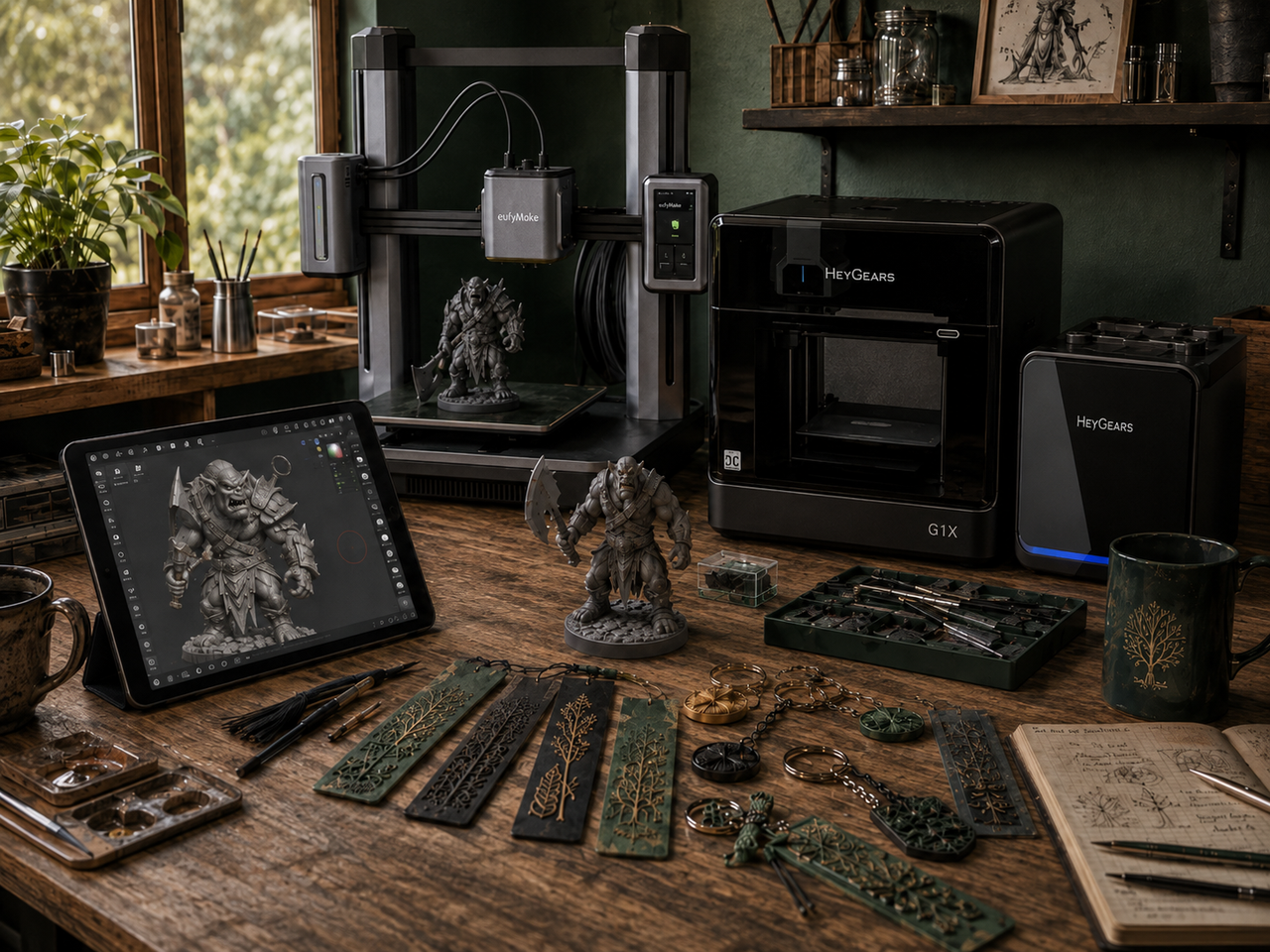
I already have several ideas I want to test, but I’m deliberately treating them as experiments rather than assuming every one of them deserves to become a product line. Because I enjoy reading, bookmarks are one of the first things I want to explore. They are relatively small, give me room to experiment with textures and designs, and connect naturally with something I genuinely enjoy.
Keychains are another possibility because they can be personalized around hobbies, places, events, pets, memories, and countless other subjects. I am also interested in experimenting with photography. I already own an Epson EcoTank 8550 that can produce excellent photographs with high-quality paper, and I want to see how some of my images might translate into textured or dimensional pieces instead of remaining traditional flat prints.
The area I am probably most excited about creatively is miniatures, figures, and statues. Fantasy, anime, games, and related artwork have interested me since I was young, and the idea of eventually creating original collectible pieces brings together several of those interests. If I can develop products people connect with, I can imagine selling them online, at Saturday markets, holiday markets, conventions, comic events, or other places where people are already looking for unique creative work.
My wife also has ideas she would like to explore, particularly around clothing designs and other products. That gives Studio the potential to become more than a collection of things I personally make. It could eventually become a creative outlet for our family.
The Equipment Is Only the Beginning
I currently own an AnkerMake/EufyMake 3D printer, which gives me a way to continue learning traditional 3D printing and experiment with prototypes and simpler products. The larger investment is a HeyGears G1X system that I am waiting for, which is intended to combine 3D and UV printing capabilities in ways that could open up different product possibilities.
Alongside those printers, I also have the Epson EcoTank 8550 for photography and high-quality photo printing. Taken together, the equipment gives me several different ways to turn digital work into something physical.
The important thing for me is not confusing access to equipment with having a successful business. It would be very easy to spend thousands of dollars on machines and then assume the business has to work because the investment has already been made. I want to avoid that mindset. If the products don’t sell, the answer is not automatically to keep buying more equipment.
The equipment gives me the opportunity to experiment. The market will decide whether those experiments have value to anyone besides me.
The Risks Are Very Real
There are plenty of reasons Studio could struggle, and I think those risks are worth acknowledging from the beginning. Equipment is expensive, but the cost doesn’t stop with the initial purchase. Ink, printing material, supports, maintenance, replacement parts, packaging, electricity, failed prints, and ordinary wear all become part of the real cost of producing a product.
Pricing those costs correctly may be one of the biggest challenges. If I price an item too low, I could make sales while still losing money once all of the hidden costs are considered. If the price is too high, customers may simply decide the product isn’t worth it. Finding that balance requires understanding the real production cost and then learning what customers are actually willing to pay.
There is also the question of demand. A product can seem like a great idea to me and still have almost no market. Competition can increase quickly. The equipment itself may have problems because newer hardware and software often take time to mature. Consumables can become expensive or difficult to source, and a machine that looks impressive during a demonstration still has to perform reliably during normal day-to-day use.
Those concerns don’t make me want to abandon Studio. They make me want to track it carefully.
If a product costs more to make than expected, I want to know exactly why. If equipment creates unexpected maintenance costs, that needs to be part of the calculation. If customers repeatedly choose one item while ignoring another, I want the data to guide what I make next.
Original Work Comes With Another Set of Responsibilities
As I create more original designs, I also need to learn more about intellectual property, licensing, and how creative work can be protected. One of my concerns is that a successful design could eventually be copied or reproduced by someone else, particularly online where artwork can travel around the world almost instantly.
There may never be a perfect way to prevent that. At the same time, I have a responsibility to respect other creators in exactly the same way I hope my own work will be respected. Being able to download a model does not automatically mean I have the right to produce and sell it commercially. If I use someone else’s work, I want to understand what the license actually permits and make sure the creator’s terms are respected.
In the beginning we will most likely purchase and utilize commercial licensing and display the creators on our items, but over time, I hope original design becomes a larger part of Studio because that gives the work a stronger identity and allows me to build skills that can’t be purchased simply by buying another printer.
Why I’m Willing to Take the Risk Now
Harding Legacy Group is still new, so spending several thousand dollars exploring another part of the business is not a decision I take lightly. The reason I’m willing to experiment is that the ideas behind HLG (Harding Legacy Group) are much older than the website itself.
I have tried many different ways to earn additional income over the years. I have experimented with photography, reselling, gig work, technology, and other ideas. The difference now is that Harding Legacy Group gives those experiments a permanent home. Instead of trying something, deciding whether it worked, and quietly moving on, I can document the experience and allow each experiment to contribute to the larger project.
That changes the value of failure. If I try a product and nobody buys it, I can still analyze what happened. If a machine turns out to have limitations I didn’t expect, I can document those limitations. If something works better than expected, I can explain why I think it worked and continue developing it.
An experiment can fail as a product and still succeed as a lesson.
I’m also fortunate to have the support of my family. We need additional ways to create income, but I don’t want desperation to become an excuse for pretending every idea will work. The goal is to take calculated risks, evaluate them realistically, and learn from the results.
How I’ll Decide Whether Studio Is Working
Ultimately, Harding Legacy Studio needs to generate positive cash flow if it is going to become a sustainable business rather than an expensive hobby. Revenue will matter, but I don’t think it will be the only measure of progress.
Success would also mean becoming better at 3D modeling, developing original products I am proud to show people, learning which ideas actually resonate with customers, and seeing people engage with the work. Repeat customers would be particularly meaningful because someone choosing to buy from us again would suggest that the value goes beyond the novelty of seeing a new type of printer.
The portfolio itself also matters. I want someone visiting Studio several years from now to be able to look backward and see the progression from early experiments to more developed work. That includes successful products, failed prints, lessons about materials, pricing mistakes, design improvements, and all the things that happen before a finished product looks effortless.
Over time, I hope those pieces begin to reinforce one another. Products can support the business financially, while the process of creating them becomes material for articles and videos. Those articles may help someone else learn or inspire an idea of their own, while also introducing new people to the products we create.
That is why I think of Studio as more than an online store. I want it to become a living portfolio of what our family learns to make.
What I Hope Studio Becomes
A year from now, I don’t need Harding Legacy Group’s Studio to be a huge business to consider the experiment worthwhile. I would like to have products people have actually purchased, a better understanding of which ideas are worth continuing, and a growing collection of original work that represents what I am capable of creating.
I would also like to see engagement around the work itself. Maybe someone buys a bookmark because the design means something to them. Maybe a miniature reaches someone who shares the same interest in fantasy or gaming. Maybe an article about a failed product helps another person avoid making the same mistake. Those forms of connection matter to me because they mean the work is reaching beyond my own desk.
Positive cash flow would still be an important milestone. The equipment, materials, and time eventually have to justify themselves if Studio is going to remain part of the business. In the end, the larger goal is to build something where creativity, technology, business, and life long learning supports one another rather than existing as separate hobbies.
What excites me most about Studio is the ability to take something I can see in my imagination, turn it into something real, and share it with the people around me.
I don’t know which products will work or exactly what Harding Legacy Studio will look like a few years from now. That uncertainty is part of why I want to document it from the beginning. If it succeeds, there will be a record of how it grew. If parts of it fail, there will be a record of what those experiments taught us.
Either way, we will have created something worth learning from.